
 CAD
CAD
For some users, having either the option of a strobe OR a video light on a single dive is not enough. Maybe part of the dive requires photographing something specific, and another involves shooting well-lit video as well. In these cases, we have a few different options to consider for covering video lighting and stills lighting in the same dive.
Option 1 (my preferred option): triple clamps and two sets of lights
In my opinion, the absolute best performance in this scenario requires both dedicated strobes and video lights, mounted on the same UW camera rig.
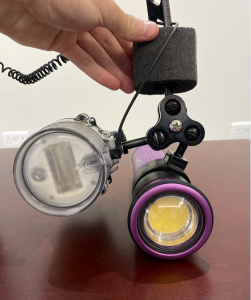
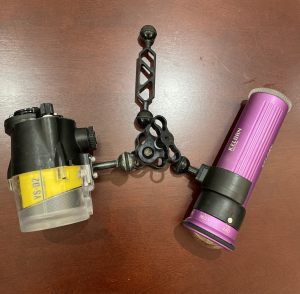
We can accomplish this in a few different ways. The best (again, in my opinion) is with triple clamps. In this configuration, you can utilize dedicated video lights and dedicated strobes on the same setup. This offers the best performance – there are no compromises in terms of performance. However, there are drawbacks. Namely: cost, size, and positioning flexibility.
In terms of cost, this may be the most expensive option, as you are purchasing four lights in total, as opposed to two. However, for those that already own video lights and strobes, this may not be an issue.
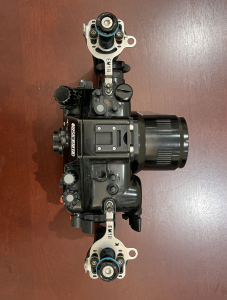
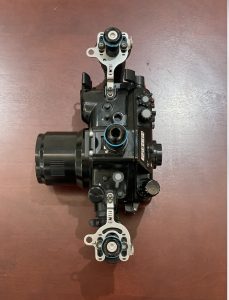
The second drawback to this configuration is size. As you can see from the following image, this is not a particularly streamlined configuration. I have the triple clamps positioned at the ends of my arms – but you could also position a triple clamp in the middle, and have a light in the between your arms, and another at the end.
However, I think it’s easier and more flexible to keep both lights on the end of your arms, instead of separating them.
Positioning your lights can be a little frustrating at times to light different scenes with a dual setup like this. It certainly takes some getting used to. And, you will need to carefully determine how much float you need from your arms/floats with the extra weight.
But, ultimately, this configuration offers the best of both the strobe and video worlds. If quality and performance is your top consideration, this is the way to go.

Option 2: integrated dual video/strobe lights
Note – this is not a video light with a “strobe mode.” By integrated dual lights I mean lights made specifically to have full video and strobe capabilities. This is an increasing segment of the underwater lighting world, but still lagging behind in options.
Recently, Ikelite have made strides with new lights in this category. For example, the Ikelite DS230s now feature an integrated, dedicated video light, and a strobe.

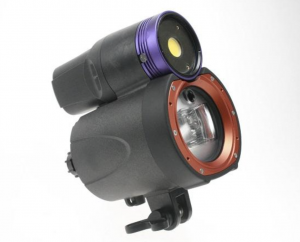
Currently, there still aren’t too many of these. iTorch was doing this for a while, but discontinued their line, and it seems like Ikelite might have the best choice in this category. However, the performance is still a little less than you can get out of a dedicated strobe + a dedicated video light.
The Ikelite DS230, for example, only has a 2300 lumen video light – compared to the 18000 lumens of the Keldans in the first section. But, I have listed this option as the second-best choice because I think in the future, this will become a really ideal option. Strobes and lights are getting stronger and smaller, and now manufacturers can fit both into one housing.
A few more years, and this may become option number one.
Option 3 (tied): video lights with strobe burst mode
Recently, video light manufacturers have started adding in “strobe functions” to their video lights. This is a really interesting feature, and also has a lot of potential. However, this is not my preferred choice in this category.
Essentially, the “strobe” fire is just a burst of video light, and usually about the same or slightly more powerful than the output of the actual video light. For example, the Kraken 8000’s have a strobe mode, at 10,000 lumens burst – 2000 lumens more than the normal output of the light.
In comparison to a typical underwater strobe, which can be around 50,000 lumens, you’re sacrificing a lot of performance in the photography department.
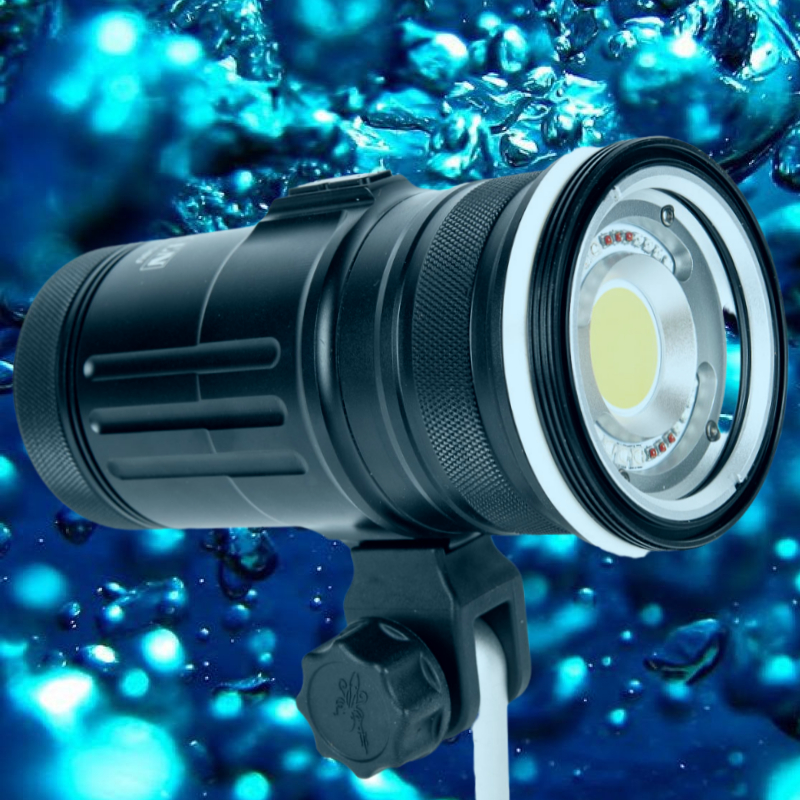
I think these video lights with strobe features will also improve in the coming years, but as of now, option one or two are better-performers.
Option 4 (tied): cold-shoe mounted video light in addition to 2 strobes
The last option here is a cold-shoe mounted video light, in addition to two strobes. This is one of the most common ways I see this done, but it’s not necessarily the best choice for performance.
In principal though, it’s simple, and does allow you some video light capability in addition to your strobes. This is a frequent choice of underwater photographers who occasionally want to shoot a little video and don’t want to complicate things.
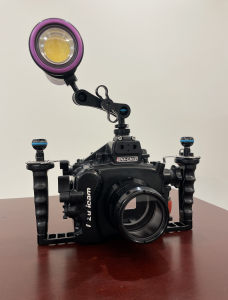
Basically, a cold-shoe mount is a special mount that connects to the notch in the top of many underwater housings (note – not all housings have this). Then, a clamp, a long clamp, or a clamp and small arm segment are used to connect the video light to the cold shoe ball.
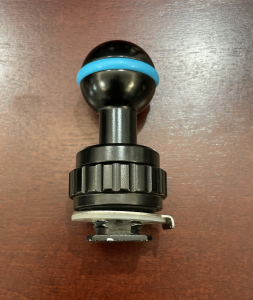
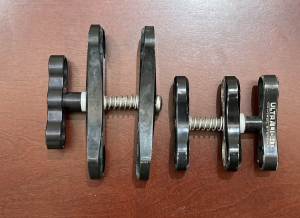
Essentially, this attaches a video light to the top of your housing. I recommend the long clamp, as it will give you more flexibility to angle your light and cut down on backscatter. A normal clamp will work, but you may have issues with the back of light being too close to your face, or you may be strictly limited to lighting directly in front of you, which creates maximum conditions for backscatter to reflect back into your lens.

- Choosing Your First Underwater Camera in 2026 – May 15, 2026
- Strobes or video lights? A head-to-head comparison for the underwater photographer – October 23, 2023
- Shooting Video AND Stills on the Same Dive [Guide] – April 6, 2023