
 CAD
CAD
Strobes or video lights? A head-to-head comparison for the underwater photographer
At one time or another, we were all beginners in underwater photography. And no matter how full of ourselves we are at this moment, we can probably all admit that when we first jumped into this, the amount of equipment choices was overwhelming. Housings, arms, clamps, trays…where do we even start? And what about LIGHTS?
Well – fear not, we’re here to help!
In this article, we’ll cover the main differences between the different types of artificial lights available to the aspiring underwater photographer.
Note: This article was updated on Oct24 by Tal Mor with new products in the market and some additional information.
Introduction to underwater photography lighting
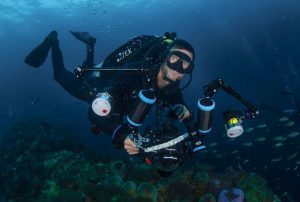
If you’ve seen an amazing underwater image, chances are it was lit by artificial light. There are plenty of situations where it may be a good idea to shoot with only ambient light, but, in general, external light is critical in producing great results.
There are several reasons for this, including filling shadows, separating your subject, etc., but the most important reason is COLOR. If you’re an experienced diver (or familiar with physical/optical oceanography) you’ve heard that as we descend into the depths of the great blue sea, colors start to disappear. They disappear in order of wavelength, with the shorter wavelengths of light (violet, blue and green) penetrating deeper and remaining visible for longer, while the longer wave lengths (red, orange, and yellow) disappear first.
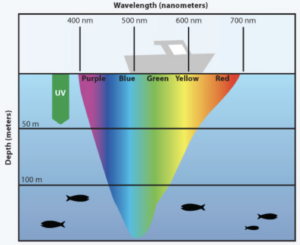
This is why colors appear blue/green at depth if uncorrected or lit artificially, and this is why external lights are so important to underwater photographers. If you want to accurately display the vibrant colors of a deep coral reef, you will need to light it up.
Now, it’s important to mention here that there are plenty of challenges with using artificial lights underwater. The first and most insidious to the underwater photographer is backscatter – or the reflection of particulates in the water column back into our lens that make it look like we’re diving in a snowstorm.
Using proper technique with your lights is critical in fighting some of these underwater evils. For more help with strobe technique, check out this article, here.
OK, so when might I NOT want to use artificial light?
This is an article about types of lights, so we won’t spend much time on this here. But, in short: if you’re very shallow in bright conditions, if you’re photographing large things very far away (like shipwrecks), if you’re photographing particularly sensitive animals, or if you need to be as streamlined/unencumbered as possible (like swimming hard to keep up with a particular moving subject). These are a few scenarios that come to mind. Most of the time though, well-controlled light is your best friend underwater. Here is a good article about shooting underwater without a strobe.

So…what are the choices for lighting up our scenes?
As you may have gathered from the title of this blog post, the main types of underwater lighting are STROBES and VIDEO LIGHTS. There is an emerging category which we’ll call “HYBRIDS” and discuss at the end, but let’s first get into the former two options.
Strobes
Strobes, or flashes, produce powerful bursts of light that are synchronized to your camera’s shutter. These fast, powerful flashes are what freeze the motion in a photograph – a confusing concept for beginners. Underwater strobes are made exclusively for photographers; they simply won’t help in the video department.
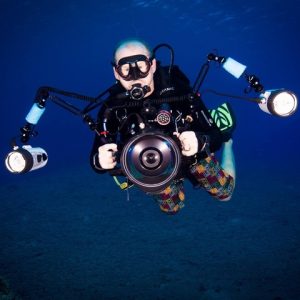
Unlike in above-water photography where camera flashes can connect directly to the top of your camera (the “hot shoe”), synchronizing your underwater strobes and your camera’s shutter is a little more complicated because our strobes are in the water, and our camera is inside of our housing. We need a way of sending the signal from our camera, through our underwater housing, and to our strobes.
Strobe Triggering

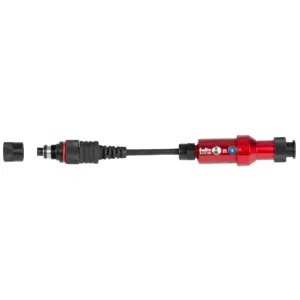
There are two main ways we do this (and you can read more about this, here). The first way is with fiber optic connections. In essence, we can trigger our strobes with a little flash (either a built-in camera pop-up flash, or a third-party flash trigger that achieves the same thing) on our camera inside the housing that flashes when the camera shutter is pressed and a fiber optic cable on the outside of the housing that is pressed against a clear window into our housing to “see” the little flash, which relays that signal to our strobe. This is the basic principle of fiber optic strobe triggering, which is the most popular form of strobe triggering today. It does not require a hole in the housing, because the fiber optic cables are on the water side of the housing.
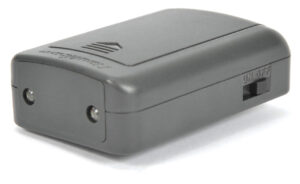
The other form of strobe triggering is called “electrical sync” triggering. This form of strobe triggering uses a bulkhead (a pass-through connection) in the housing that connects a cable directly from the strobe, through the bulkhead, and to a hot shoe harness.
Things to look for in a strobe
Power (Guide Number)
The power of an underwater strobe is typically represented by a guide number. The higher the guide number, the more powerful the strobe. Mathematically, guide numbers are calculated by multiplying distance by F stop. For example, a strobe with a guide number of 30 (meters, above water), might have a guide number of 14 underwater. This means, if you are shooting at a subject 1 meter away at full strobe power, at ISO 100, F14 will give you the correct exposure. At 2 meters away, you will need a larger aperture, F7, and so on.
Typically, today’s more powerful strobes will have a guide number around 30. Smaller strobes may be around 20.
Recycle time
One important consideration for strobes is that, unlike video lights, strobes must recycle (or kind of recharge) between shots. In the past, this was a slow (sometimes many seconds at full power) process. However, today’s underwater strobes are often very fast to recycle – in some cases, 1 second or less. In this case, the recycle time of your strobe may be limited to the recycle of your camera flash as opposed to the strobe; this could be a good reason to get a flash trigger which recycles faster.
Beam angle
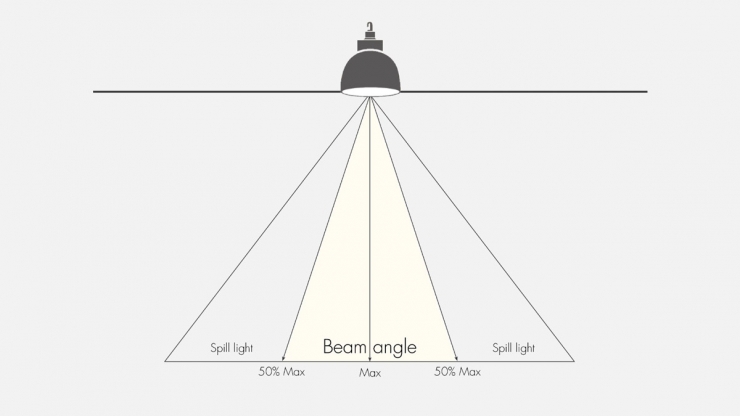
The beam angle refers to how wide or narrow the cone of light coming from your light will be. This is an important consideration for both strobes and video lights. Typically, wider is better for us underwater, unless you’re shooting something specific like caves or cenotes and want a model to have a narrow beam or a spotlight on a physical feature.
90 to 100 degrees and up is a starting place for a nice wide beam angle.
Battery life
Strobes are typically rated for a certain number of shots per battery charge. Look for this number, which is often between 150-300 shots per charge.
Many strobes use rechargeable AA batteries – the type and quality of these batteries is important! Panasonic Eneloop batteries have consistently been a top choice for rechargeable strobe batteries.
Conclusion: strobes
-Strobes are extremely powerful compared to other lights – often in the 50,000-lumen and upwards range.
-Strobes freeze motion which means they make your images sharper even at low power.
-Strobes are relatively complex (triggering) compared to other types of light.
-Strobes only turn on when you fire them, so you don’t necessarily know what the scene will look like before you press the shutter. Some strobes offer target or focus lights to help aim.
-Strobes are only useful for photographers.
-Strobes are less expensive than other types of lights, all things considered.
Video Lights
Video lights are CONSTANT sources of light. Like a flashlight you’re accustomed to using above water, a video light is turned on, and it stays on. This is quite different from a strobe as discussed above, which emits a burst of light, exactly like an above water strobe or camera flash does.

Can you use video lights for photography?
YES. And this is one major reason for this article. As we highlight above, strobes only work for photography. Video lights, on the other hand, can be used for photography AND videography, which can be a big bonus. However, there are some important things to consider.
Power
In general, video lights are rated in lumens, while strobes are rated by guide number. As we mentioned above, strobes are very powerful – often in the 50,000 lumen range – and video lights are comparatively weaker. Unlike the flash of a strobe, constant light sources rely on your camera shutter, not the flash, to freeze motion. This means that you need higher shutter speeds to capture images without blur.
Video lights come in many different power levels, measured in lumens – from smaller, weaker lights often just used for focusing in the 1,000 lumen range, all the way up to large, expensive professional video lights of 20,000 lumens or more.
A common range of high-quality, powerful video lights today is around 8,000 to 15,000 lumens, with prices for this range of lights somewhat similar to our high-end strobes (600 to 1000 dollars).
Beam angle
Beam angle is as critical for video lights as it is for strobes, and perhaps more so. We really want a nice wide beam angle, look for 100 degrees and up.
Battery life
Unlike in strobes, which are rated by shots per charge, video light battery life is typically measured in burn time. Burn time refers to the length of time you can run the light at a specific power level before the battery runs out.
Color temperature and color accuracy
Both strobes and video lights have a certain color temperature of light they produce. This is usually represented by kelvin temperature. 4700 to 5600K is usually in the range of most underwater lights.
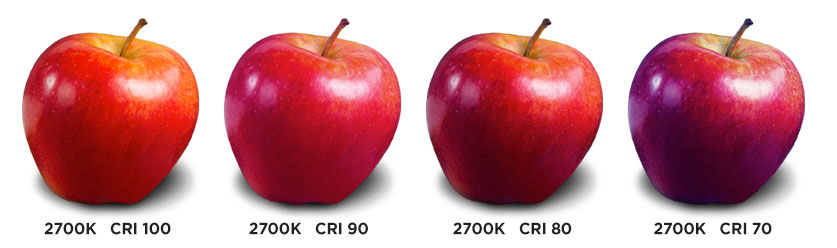
Color accuracy is a measure of how things illuminated by our lights look in comparison to when they’re under natural light. This is measured in CRI, or Color Rendering Index, on a scale of 0-100. The closer to 100, the more the colors of our subjects look like they are illuminated by sunlight. A good CRI is in the mid 80’s and up.
Conclusion: video lights
-Video lights can be used for both photos and videos
-Video lights are far less powerful than strobes and certainly are bigger in size for the same amount of light.
-Video lights are simple to use. When they’re on, they’re on.
-Video lights offer real-time feedback on the scene in front of you. You can see where the light is pointing and what is illuminated in your camera.
-Video lights typically burn through battery much faster than strobes.
-Video lights can get considerably more expensive than strobes at the higher ranges of their performance spectrum.
So, which should I use? Which is better?
Ok, so if you’ve made it this far and you still don’t know if you should go for strobes or video lights, let’s break down what might fit your needs one way or the other.
The first, and most obvious, component is: are you planning on shooting a lot of videos? For video shooters, this is a simple choice. Strobes are not useful for underwater videographers, because they are not constant light sources and thus do not serve us in this arena. If you want to shoot a lot of video with your underwater rig, get two video lights and call it a day. You’ll still be able to take some still photographs with your video lights.
If, like many underwater photographers starting out, you are NOT planning on shooting much video, the decision becomes a little more complicated. Let’s dive in.
If you’re an experienced above-water photographer who mostly shoots still images and has some (even basic) experience with flashes – underwater strobes are probably the way to go here. They typically offer a LOT more power than video lights, freeze motion, and allow for more shots per dive in terms of battery life. They also offer room for more creative control than video lights; you can experiment with slow shutter speeds to get motion blur with sharp details (learn more, here), you can use them off camera with wireless triggers, and more.
If you’re a beginner underwater photographer who plans on mostly shooting stills…the strobes route is still probably the best way to go. There may be a small learning curve to using your strobes, but with a little patience and trial and error, you’ll get great results with a pair of strobes.
Now, for one of our most common questions at Mozaik: what if I want to shoot both video and stills? What if I want to shoot mainly photos, but also some well-lit videos? What do I do!?
For the true “hybrid” shooter, who really wants to make videos AND still images, there are a few interesting options. Standard strobes are not going to work for this scenario, as they won’t allow for that video component.
So, we are left with essentially three options:
a) shoot videos with video lights and some stills also with video lights, b) use strobes for stills and video lights for videos, on the same rig or c) use a combined video/strobe light.
Let’s go through these one by one.
Option 1. Shoot videos and stills with one pair of powerful video lights
This is certainly a doable proposition, and many hybrid shooters (and some that only create stills) opt for this one. If you want to go this route, it’s important to choose a strong, wide angle video light. Remember you are sacrificing a lot of power in using a constant light over a strobe, so choose carefully. When shooting stills with a video light, remember to watch your shutter speed carefully, as you will get blurry shots if you’re shooting in Aperture priority mode in some low light conditions if you don’t adjust iso and aperture around shutter speed.
Option 2. Use strobes for stills and video lights for videos, on the same rig

This is the option that will likely result in the absolute best quality, but with a few big drawbacks. In principle, strobes will do a better job with stills and video lights obviously are better with videos. So, using each light for what they’re designed for makes sense. However, this means instead of buying two (expensive) lights, you’re buying four. That can be a big ouch to the bank account. It also means that you’re going to have to push around a bigger, less streamlined camera rig underwater, and likely use more arm and clamp hardware to mount them. My favorite way of doing this is by using triple clamps to mount strobes and video lights on the same arms. Here’s a great article about the different ways to mount both strobes and video lights.
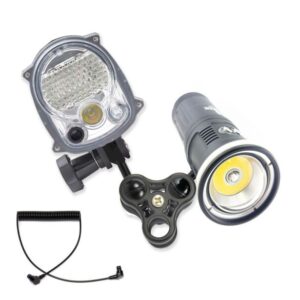
Option 3. Use a combined video/strobe
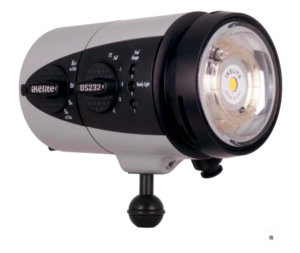
This is a really exciting area of development in the underwater lighting world, and hopefully it will only get better. Some manufacturers are producing lights with both strobes and video lights in one integrated unit, offering the benefits of option 2, without the drawbacks of buying four lights and having to use extra arms and clamps.
Currently, a great example of that looks to be the Ikelite DS230 213Ws strobe, which features an integrated video light around a GN32 strobe.
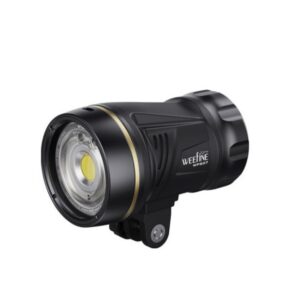
Kraken also makes a variety of video lights with “strobe features”, usually a fiber optic pulse mode that pulses a burst of light from the video light to simulate a standard strobe. While this sounds ideal, it’s not perfect – it’s not the same mechanics as a true strobe and doesn’t the same typical power of a strobe flash.
Conclusions
Hopefully, this didn’t make your decision even harder…we know there are a lot of different choices! If you’re feeling overwhelmed, we’re happy to help. You can always contact us for personalized recommendations, shoot us a note at [email protected].

- Choosing Your First Underwater Camera in 2026 – May 15, 2026
- Strobes or video lights? A head-to-head comparison for the underwater photographer – October 23, 2023
- Shooting Video AND Stills on the Same Dive [Guide] – April 6, 2023

1 comment
One other advantage of having at least one video light on the rig is for your own enjoyment during the dive. You can actually see and appreciate the colorful biology that you hope to capture for posterity with the strobe.