
 CAD
CAD
OM System EM10 IV vs Canon R100 vs Canon R10
I’ve decided to write this article during the Black Friday rush. I’ve spoken to many that are considering to upgrade their camera to mirrorless this weekend and the “affordable” mirrorless category is a popular choice.
I’m going to compare 3 cameras here:
OM System EM10 IV – bundle with AOI housing costs $1,398
Canon R100 – bundle with Ikelite housing costs $1,650
Canon R10 – bundle with Ikelite housing costs $3,295
All three housings are very compact and the kit lenses are pretty similar. The EM10 IV comes with a 14-42mm lens and the Canon’s with a 18-45mm lens.
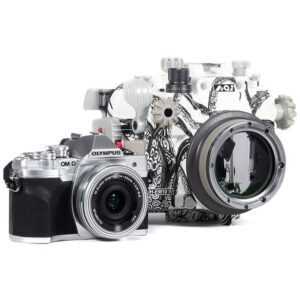
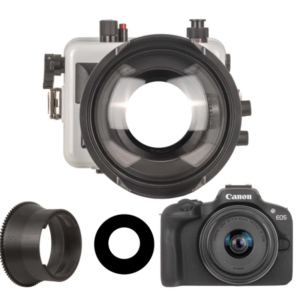
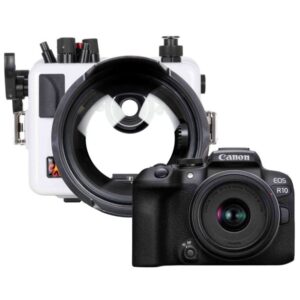
The biggest and most notable difference between the OM system and Canon is that in the case of the EM10 IV the housing comes with flat port that supports wet lenses (and you can add both a wide and macro lens). The Canon’s come in an Ikelite housing that only supports the kit lens behind a dome and that means no wet lenses. If you want macro, you’re going to have to get an additional lens (like Canon 100mm) and port which now makes this combination not so affordable.
The advantage of the Dome and therefore the Canon’s is that for wide angle and all around photography, the lens/port combination is much better out of the box from the EM10. This is because a dome port gives you 25% more magnification and a sharper image so your kit lens, the 18-45mm functions under water the same as it does above water.
Ok, now let’s compare the cameras.
| Specification | OM System EM10 IV | Canon EOS R100 | Canon EOS R10 |
|---|---|---|---|
| Model | Olympus OM-D E-M10 IV | Canon EOS R100 | Canon EOS R10 |
| Resolution | 20.30 Megapixels | 24 Megapixels | 24 Megapixels |
| Sensor Size | 4/3 (17.4mm x 13.0mm) | APS-C (14.9 × 22.3 mm) | APS-C |
| Kit Lens Zoom | 3.00x (14-42mm, 28-84mm eq.) | F4.5-6.3 IS (18-45mm) | F4.5-6.3 IS (18-45mm) |
| Native ISO | 200 – 25,600 | 100 – 12,800 | 100 – 32,000 |
| Extended ISO | 100 – 25,600 | Up to 25,600 | Up to 51,200 |
| Shutter Speed | 1/16000 – 60 sec | 1/4000 | 1/16000 |
| Weight (with Kit Lens) | 1.05 pounds | 0.78 lbs | 0.93 lbs |
| Image Stabilization | 5-axis, up to 4.5 stops | No IBIS | No IBIS |
| Autofocus System | 121-point contrast-detect | 143 zones (stills) | Unknown |
| Continuous Shooting Speed | Up to 15 fps | 3.5/6.5 fps | Up to 23 fps |
| Video Capability | 4K/30p, 1080p up to 60p | 1080p up to 119.98 fps | 4K up to 60 fps |
| Connectivity | Wi-Fi, Bluetooth | Mono mic, 3.5mm stereo | Unknown |
| Battery Life | 360 shots | 370 shots | 450 shots |
| Charging Port | Micro USB | USB-C | USB-C PD power |
Since the Canon R10 is a significant jump in price from the other two, I feel that I need to explain why that extra investment may be worth it.
Does the Canon R10 justify the extra dollar?
If you have to choose between this upgrade or lights, I would certainly choose lights so please only consider this upgrade if you can afford both.
The Canon R10 has Canon’s new auto focus system and the R100 was left behind. This means the R10 has a huge advatange in terms of the speed and accuracy of the auto focus and thats major.
This is a result of the R10 having Canon’s new sensor which also affects its image quality and low light capabilities. Basically, the R100 is a new version of the older M50 so while it is branded as a new model in Canon’s line up, the electronics inside are the older models.
Bottom line, definitely worth the extra $800-$1000 but only if you don’t have to give up lights which I always say are the most important thing to get good photos and videos.
Is the Canon R100 better than the EM10 IV?
Yes
- Because it has a larger sensor and that usually means better image quality.
- It is also much lighter and very small in size.
No
- The EM10 IV has built in Image stabilization
- The Octo housing allows shooting macro with a simple addition of a diopter and allows shooting great wide angle with an additional wet wide angle lens.
- The EM10 IV has much higher max shutter speed and supports much faster continous shooting. It also has a higher max ISO although the R100 is expected to have better image quality at the high ISO ranges.
Bottom Line
Not an easy choice to make and probably a very personal one but I hope this article has enough information to help you make that decision.
About the Author
Mari Herrarte
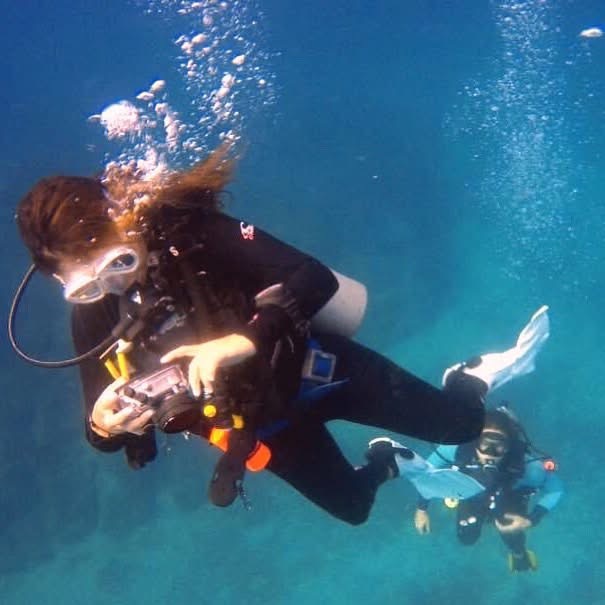
Mari has been diving for 15 years and loves spending time in the ocean, surrounded by nature. She is also passionate about photography and capturing the beauty she discovers underwater.
- Cabo Pulmo Diving: A Beginner’s Guide – September 28, 2026
- How to Adjust Underwater Camera Settings as Conditions Change – September 22, 2026
- Why Your Underwater Photos Look Too Dark and How to Fix Them – September 16, 2026