
 CAD
CAD
Affordable Underwater Camera Systems in 2026: Best Alternatives to Expensive DSLR Housings
Underwater housings for DSLR and high-end mirrorless cameras can cost more than the camera itself. Once you add ports, zoom gears, strobes, wet lenses, trays, arms and video lights, the full system can become expensive fast.
The good news is that you do not need a full DSLR housing to start taking strong underwater photos and videos. In 2026, many divers can build a smart starter system with a rugged compact camera, a GoPro, a smartphone housing, a premium compact, a used setup, or an entry-level mirrorless housing.
This guide compares the best affordable alternatives, explains what each setup is good for, and shows where your money matters most: reliable housing, lighting, wet lenses, travel size and a system you can actually enjoy diving with.
What Is the Best Alternative to an Expensive DSLR Housing?
For most beginner and travel-focused underwater photographers, the best alternative to an expensive DSLR housing is a compact or rugged camera system with lighting. The OM System TG-7 with a housing and strobe is one of the strongest simple photo options. GoPro is best for easy video. A smartphone housing is good for divers who want to use the phone they already own. Entry-level mirrorless systems like Canon EOS R100 or Sony a6700 make sense when you want better image quality and room to grow.
| Setup type | Best for | Main advantage | Main limitation |
|---|---|---|---|
| Smartphone housing | Casual divers, travel, social content | Uses the phone you already own | Limited ergonomics and upgrade path compared with camera systems |
| GoPro or action camera | Video, travel, freediving, simple shooting | Small, easy and strong for wide video | Less flexible for serious still photography |
| OM System TG-7 style rugged compact | Beginners, macro, simple dive trips | Simple, tough, compact and strong for macro | Smaller sensor than premium compact or mirrorless cameras |
| Premium compact | Travel photographers who want better image quality | Small system with good photo and video quality | Fixed lens and limited long-term growth |
| Used compact system | Budget buyers | Can save money if the housing is in good condition | Availability, parts and support may vary |
| Entry-level mirrorless | Growing photographers | Better image quality and interchangeable lenses | Higher cost for ports, lenses and lighting |
| Full-frame mirrorless | Advanced underwater shooters | Best image quality and system flexibility | Most expensive system path |
Why DSLR and Mirrorless Housings Cost So Much
DSLR and mirrorless cameras are mass-produced, but underwater housings are not. A housing has a much smaller market, more specialized engineering, tighter testing needs and far more risk if something goes wrong.
A serious housing must protect an expensive camera and lens in saltwater, pressure, sand, travel abuse and repeated dives. It also needs controls that let you change settings underwater, connect strobes, use ports and lenses, and keep the camera dry.
The housing is only the first cost. A full interchangeable-lens system may also need dome ports, flat ports, extension rings, zoom gears, focus gears, strobes, sync cables, video lights, trays, arms, clamps and floats.
That is why many divers are better served by starting with a smaller system, then upgrading once they know what they actually enjoy shooting underwater.
Best Affordable Alternatives to DSLR Housings in 2026
The right choice depends on your budget, dive style and creative goals. Someone who wants vacation video does not need the same system as someone shooting macro nudibranchs or wide-angle reef scenes.
| Your goal | Best starting point | Why it works |
|---|---|---|
| Simple underwater video | GoPro or action camera | Small, easy and reliable for wide-angle video |
| Macro photos on a beginner budget | OM System TG-7 kit | Excellent close-focus ability in a compact system |
| Social content and casual travel | Smartphone housing | Lets you use a phone camera you already know |
| Better image quality in a small system | Premium compact | Travel-friendly with stronger photo and video quality |
| Long-term growth | Entry-level mirrorless | Interchangeable lenses and better upgrade path |
| Lowest possible cost | Used system | Can be a good value if carefully inspected |
Option 1: OM System TG-7 and Rugged Compact Systems
For many divers, a TG-7 style rugged compact system is one of the smartest ways to start. It is small, tough, easy to travel with and especially strong for macro and close-up subjects.
The TG-7 path works well if you want something simple, reliable and expandable. You can begin with the camera and housing, then add a tray, strobe, video light, wet lens or fiber optic cable when your skills grow.
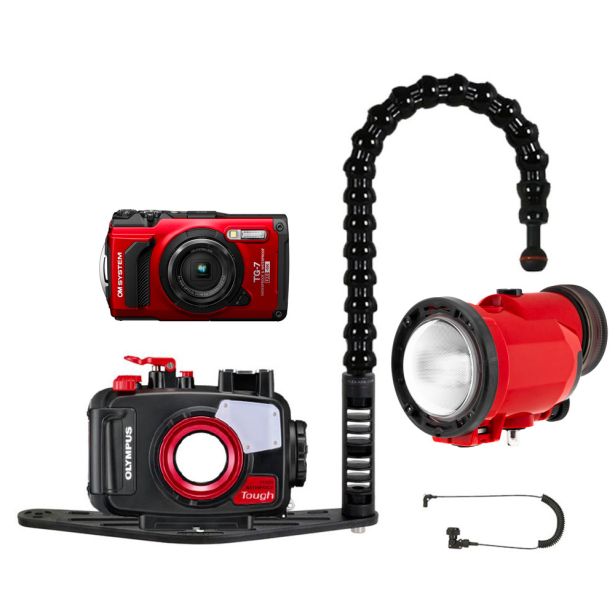
This kit includes the TG-7 camera, PT-059 housing, Inon S-220 strobe, fiber optic cable and Mozaik flex-arm tray package. It is rated to 45m / 148ft and is built as a compact, travel-ready underwater photo system.
Best for
- New underwater photographers
- Divers who want strong macro ability
- Travel divers who want a small kit
- People who want lighting without building a large system
Option 2: GoPro and Action Camera Systems
A GoPro is one of the easiest ways to capture underwater video. It is small, simple, wide and easy to travel with. For divers who mainly want reef clips, freediving footage, trip memories, social content or action-style video, it can be a very practical starting point.
The limitation is still photography. A GoPro can take stills, but it does not give the same control, lighting flexibility or macro performance as a dedicated compact or mirrorless system.
Product example:
T-Housing Action Cam Housing for GoPro HERO 13 / 12 / 11 / 10 / 9 Black.
This is a high-end aluminum housing path for divers who want more serious GoPro depth, protection and heat management than the standard action camera case. Mozaik also has a dedicated
GoPro underwater housings category
and
GoPro accessories category.
Best for
- Video-first divers
- Freediving and travel
- Simple wide-angle footage
- Divers who want a small backup camera
Option 3: Smartphone Housings
Smartphone housings have become much more serious in recent years. They are no longer only for casual snapshots. For divers who already own a strong phone camera and want a familiar workflow, this can be a very practical entry point.
Smartphone housings make sense if you want travel photos, short video clips, social content and a system that does not require learning a new camera body. The trade-off is ergonomics, battery management, app behavior, accessory compatibility and less dedicated camera control than a real compact or mirrorless setup.
Product examples:
DIVEVOLK SeaTouch 4 Max Underwater Smartphone Housing
and
SeaLife SportDiver Smartphone Housing.
Mozaik also has a
smartphone housing packages category
for divers who want to build a phone-based underwater setup with lights, trays or accessories.
Best for
- Divers who want to use their phone camera
- Travel and casual content
- Simple underwater photo and video
- People who want a lower-cost entry point
Option 4: Premium Compact Camera Systems
Premium compact systems are still a strong middle ground. They are smaller than mirrorless systems, easier to travel with and usually more affordable than interchangeable-lens setups. At the same time, they can offer better image quality and control than action cameras or basic phones.
This category is useful for divers who want a serious camera but do not want to carry ports, multiple native lenses and a large housing system. Add wet lenses and lighting, and a compact system can cover macro, wide-angle and video on the same trip.
Product category:
Compact camera and housing bundles.
Product example to verify before publishing:
Ikelite 6116.18 Underwater Housing and Sony RX100 VII Camera.
This page describes a compact 1-inch sensor system rated to 200ft / 60m, but the page also shows a discontinued stock signal. Use it as an educational compact-system example unless Mozaik confirms current availability.
Best for
- Travel photographers
- Divers who want better photo quality than an action camera
- Shooters who want wet-lens flexibility
- People who want a smaller system than mirrorless
Option 5: Entry-Level Mirrorless Systems
Mirrorless systems are now the main advanced path for underwater photography. If you want interchangeable lenses, better image quality, stronger autofocus and more room to grow, an entry-level mirrorless setup can make more sense than buying an old DSLR housing.
The key is choosing a mirrorless camera and housing system that keeps the total setup realistic. A smaller APS-C mirrorless camera can be a good step up without jumping straight into a large full-frame system.
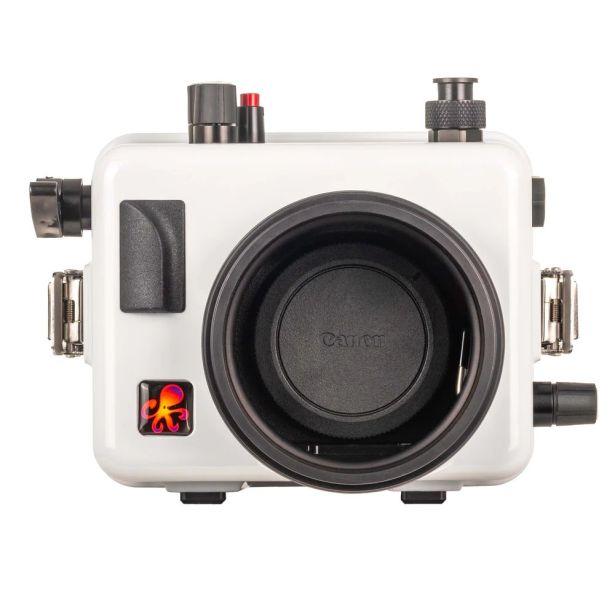
This housing is rated to 200ft / 60m and uses Ikelite’s DLM port system. It is a strong example of a more affordable mirrorless housing path for divers who want to grow beyond compact cameras.
Another current mirrorless path:
Ikelite IK-69123 Underwater Housing with Sony a6700 and 16-50mm Lens.
Best for
- Photographers who already understand camera settings
- Divers who want interchangeable lenses
- People who want better image quality and autofocus
- Shooters who plan to grow into strobes, ports and lens systems
Option 6: Used Underwater Camera Systems
Used underwater camera gear can be a good way to save money, especially if you are buying a complete system from a reliable source. A used compact setup, used housing or used light package can give you more value than buying every accessory new.
Be careful with used housings. Always check o-rings, controls, corrosion, previous flooding history, port condition, electronics, vacuum system, leak detector and whether spare parts are still available.
Category link:
Mozaik Used Items.
Best for
- Budget buyers
- Divers comfortable checking used gear carefully
- People who want a complete setup at lower cost
- Buyers who can accept limited availability
Cost Comparison: DSLR, Mirrorless, Compact, GoPro and Smartphone
The camera body is only one part of the cost. The underwater housing, ports, lighting and lenses often decide the real budget.
| System path | Typical cost behavior | Where the money goes |
|---|---|---|
| Smartphone housing | Lowest entry cost if you already own the phone | Housing, tray, lights, accessories |
| GoPro / action camera | Low to moderate | Housing, filters, tray, video lights |
| TG-7 rugged compact | Moderate and practical | Housing, strobe, tray, wet lenses |
| Premium compact | Moderate to high | Housing, strobes, wet lenses, lighting |
| Entry-level mirrorless | Higher but expandable | Housing, ports, lenses, gears, strobes |
| Full DSLR or full-frame mirrorless | Highest | Housing, multiple ports, lenses, strobes, arms, travel cases |
Where Your Money Matters Most
If your budget is limited, spend carefully. The best camera body will not help much if your housing is unreliable, your lighting is weak or your system is too heavy to enjoy diving with.
- Housing reliability: choose a housing that protects the camera and gives you access to the controls you actually need.
- Lighting: strobes and video lights often improve underwater results more than upgrading the camera body.
- Wet lenses: compact systems become much more flexible with macro and wide-angle wet lenses.
- Tray and arms: stable handling makes a big difference underwater.
- Travel size: a smaller system you actually bring on every trip is often more useful than a large system that stays home.
Recommended 2026 Underwater Camera Paths
| Budget / user type | Recommended path | Mozaik link |
|---|---|---|
| Lowest-cost casual setup | Smartphone housing | Smartphone housing packages |
| Video-first beginner | GoPro with housing, tray and filters | GoPro housings |
| Best simple photo starter | TG-7 with housing and strobe | TG-7 and Inon S-220 kit |
| Best compact camera path | Premium compact system with wet lenses | Compact bundles |
| Best growth path | Entry-level mirrorless | Canon EOS R100 Ikelite housing |
| Compact advanced mirrorless | Sony a6700 underwater kit | Sony a6700 Ikelite kit |
| Lower-cost used path | Used compact, housing or lighting setup | Used items |
Compact Systems vs DSLR Housings
A compact camera is easier to travel with, easier to dive with and easier to expand using wet lenses. This matters because underwater photography already adds a lot of task loading: buoyancy, marine life, lighting, water clarity, depth, current and dive safety.
For many new underwater shooters, the smaller system leads to better results because it is easier to handle. You can focus more on composition, approach, light and stability.
DSLR and full-frame mirrorless systems still have advantages in image quality, lens choice, low-light performance, autofocus, dynamic range and professional output. They make sense when you are ready for a larger system and know exactly what you want to shoot.
Wet Lenses: The Biggest Advantage of Compact Systems
Compact cameras have fixed lenses, but underwater that can become an advantage. With wet lenses, you can switch between macro and wide-angle during the same dive. That is much harder with DSLR or mirrorless systems, where the lens and port are usually chosen before entering the water.
This means a compact user can photograph a nudibranch, then remove or switch a wet lens and shoot a turtle, reef scene or diver portrait on the same dive.
Related guide:
The Ultimate Guide to Underwater Wet Lenses.
Wet lens category:
Mozaik Wet Lenses and Filters.
Lighting Matters More Than Beginners Expect
Water removes color quickly. Even a good camera can produce flat blue or green images if there is no added light. For still photography, a strobe is often the most important upgrade after the camera and housing. For video, a good video light can make your footage look much cleaner.
Related guides:
Ultimate Guide to Underwater Strobes
and
Ultimate Guide to Underwater Video Lights.
Current Mozaik lighting categories:
Underwater strobes
and
Underwater video lights.
Should You Still Buy a DSLR Housing?
A DSLR housing can still make sense if you already own the camera, lenses, ports or strobes, and if you find a reliable housing in good condition. It can also make sense for photographers who love a specific DSLR body and already understand the system.
For most new buyers in 2026, mirrorless or compact systems make more sense. Mirrorless gives you the advanced system path. Compact, TG-7, GoPro and smartphone housings give you easier and lower-cost entry points.
The smartest choice is not the biggest camera. It is the system that fits your budget, dive style, travel needs and the type of images you actually want to make.
Common Beginner Mistakes
- Spending the whole budget on the camera and forgetting lighting.
- Buying a large housing before knowing what subjects they enjoy shooting.
- Choosing a system that is too heavy to travel with comfortably.
- Ignoring wet lenses when building a compact setup.
- Buying used housings without checking o-rings, corrosion and leak history.
- Assuming GoPro is enough for serious macro stills.
- Assuming a smartphone housing will replace a complete camera system for every use case.
- Buying a mirrorless housing without budgeting for ports, lenses and gears.
FAQ: Affordable Underwater Camera Systems
What is the cheapest way to start underwater photography?
The cheapest practical path is usually a smartphone housing or GoPro setup if you already own the phone or camera. For stronger still photography, a rugged compact such as a TG-7 system is often a better starting point.
Do I need a DSLR housing for good underwater photos?
No. You can take strong underwater photos with compact cameras, TG-7 systems, premium compacts and mirrorless systems. Lighting, buoyancy, subject approach and practice often matter more than camera size at the beginning.
Is a compact camera better than a GoPro underwater?
For still photography and macro, a compact camera is usually better. For simple wide video, action footage and travel clips, a GoPro is often easier.
Is the OM System TG-7 good for underwater photography?
Yes. The TG-7 is a strong beginner-friendly underwater camera path, especially for macro and close-focus subjects. It becomes more capable when paired with a housing, strobe, tray and wet lenses.
Are smartphone housings worth it for diving?
They can be worth it for casual divers, travel content and people who want to use a phone camera they already know. Dedicated compact and mirrorless systems still give better ergonomics and long-term camera-system growth.
Should I buy a used underwater housing?
Used housings can be a smart value if they are in good condition. Check o-rings, buttons, corrosion, port glass, leak detector, vacuum system, previous flood history and spare part availability before buying.
When should I upgrade from compact to mirrorless?
Upgrade when you know what you want to shoot, understand lighting and buoyancy, and are ready to invest in lenses, ports, gears, strobes and a larger travel setup.
What costs more: the camera or the underwater accessories?
In many systems, the housing, ports, lights, strobes, lenses, arms and accessories can cost more than the camera body. Always budget for the full system, not only the camera.
Do I need strobes or video lights first?
Choose strobes first if your main goal is still photography. Choose video lights first if your main goal is video. Some divers eventually use both.
What is the best underwater camera setup for travel?
For travel, the best setup is usually a compact TG-7 system, a premium compact, a GoPro or a smartphone housing. These are easier to pack and dive with than large DSLR or full-frame mirrorless systems.
Final Thoughts
A DSLR housing is no longer the only serious path into underwater photography. For many divers, a compact camera, rugged TG-7, GoPro, smartphone housing, used system or entry-level mirrorless setup is a smarter place to start.
Choose GoPro or smartphone if you want simple video and travel content. Choose a TG-7 style compact if you want an easy dive camera with strong macro ability. Choose a premium compact if you want better image quality and wet-lens flexibility. Choose mirrorless when you are ready to invest in lenses, ports, lighting and a larger system.
The smartest setup is the one you can afford, carry, dive with comfortably and improve over time. If you are unsure, send Mozaik your budget, camera experience and dive style, and the team can help you build a system that makes sense before you spend too much.
Related Guides
- Choosing Your First Underwater Camera
- Smartphone vs GoPro vs TG-7 for Underwater Photography
- The Ultimate Guide to Underwater Wet Lenses
- Ultimate Guide to Underwater Strobes
- Ultimate Guide to Underwater Video Lights
- Ultimate Lens Guide for Mirrorless Cameras Underwater
- Recommended Settings for Underwater Compact Cameras

Visit his personal portfolio at www.ranmorphoto.com.
