
 CAD
CAD
Choosing Your First Underwater Camera
Whether you’ve been diving for years or just finished your Open Water course, at some point the thought hits you:
“I need a camera. Otherwise nobody is going to believe I saw that 10-foot shark right next to me.”
And honestly, that’s how it starts for most of us.
Underwater photography begins as a way to share the experience. The colors, the marine life, the moments that feel unreal once you’re back on the boat.
But choosing your first underwater camera can feel overwhelming. There are compact cameras, action cameras, mirrorless systems, housings, strobes, wet lenses… and suddenly what seemed simple turns complicated fast.
That’s exactly why we created this guide.
Before looking at specific models or brands, the most important step is asking yourself a few key questions.
The first one is:
What do I actually want to photograph underwater?
Are you mainly diving on tropical reefs and want colorful wide scenes?
Do you love small critters and want detailed macro shots?
Are you just looking for a simple system to document your dives?
Your answer to this question will shape everything that comes next.
How Good Are My Diving Skills?
Before thinking about megapixels or camera brands, be honest with yourself about one thing: how comfortable are you underwater?
When you’re new to diving, there’s already a lot going on.
You’re trying to:
-
Maintain neutral buoyancy
-
Stay in a stable horizontal position
-
Avoid touching coral or sea urchins
-
Monitor your air supply
-
Keep track of your dive buddy
-
Stay aware of your surroundings
That’s a full workload on its own.
Adding a camera too early can divide your attention. When that happens, something usually suffers. It might be your buoyancy control, your air consumption, your situational awareness, or worse, the marine life around you.
Underwater photography should never come at the expense of safety or environmental responsibility.
If you’re still working on buoyancy and trim, it’s usually better to gain more dive experience first. Once you feel relaxed and fully in control underwater, adding a camera becomes much more enjoyable and far safer.
A good rule of thumb: if you can hover motionless for at least 30–60 seconds without sculling your hands or finning constantly, you’re probably ready to start thinking about bringing a camera down with you.
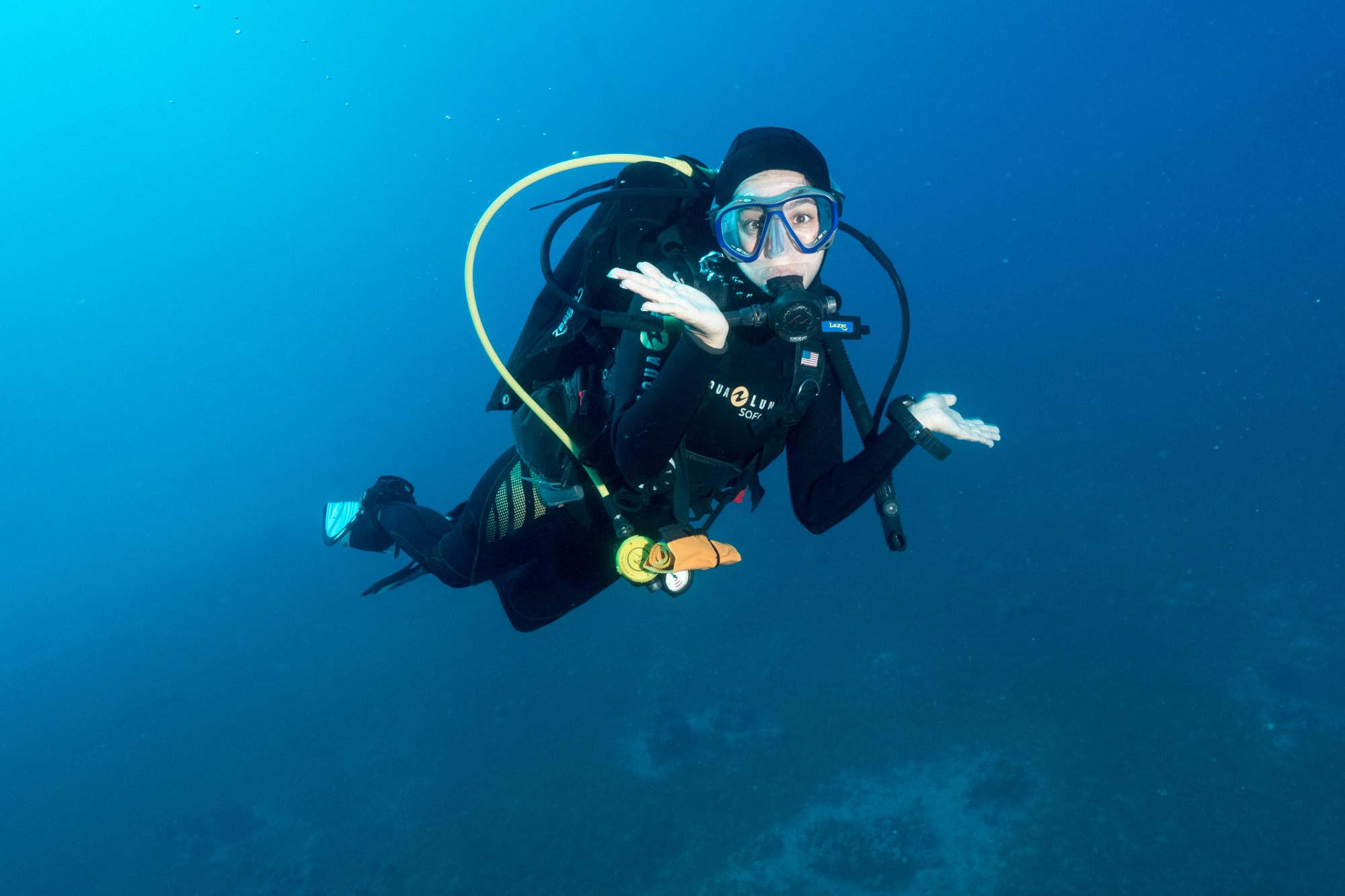
If you’ve just completed your Open Water certification and only have 5–10 dives, give yourself more time before adding a camera. Trust me on this one.
With so few dives, your brain is still busy managing the basics. Adding a camera too early can distract you from buoyancy, awareness, and safety.
If you have around 20–50 dives and feel reasonably comfortable underwater, you might consider starting with a simple action camera. These systems are lightweight, compact, and usually don’t require constant setting adjustments during the dive.
Once you reach 50+ dives and feel confident in your buoyancy control, you can look into a compact camera system, possibly with a single strobe or video light. This setup gives you more creative control without becoming overly complex.
I generally wouldn’t recommend jumping into a DSLR or mirrorless system before 80–100 dives and solid mastery of buoyancy skills. Larger systems are heavier, more complicated, and demand much better trim and stability underwater.
That said, these numbers are not strict rules. Everyone learns at a different pace. Some divers feel confident quickly, while others need more time.
Just be careful not to overestimate your skills.
Conditions can change quickly underwater. Calm, pool-like visibility is very different from strong currents, surge, low visibility, equipment issues, or unexpected situations. The more comfortable you are handling those variables without a camera, the more enjoyable your photography journey will be once you bring one along.
So what are my options?
Action Cams
Action cameras are small, rugged, and easy-to-use cameras designed to handle challenging environments, including underwater conditions. They capture a very wide field of view and offer surprisingly good image quality for their size.
Most action cams have minimal buttons and simple menus, making them ideal for use during activities where your attention is divided, including diving.
They are primarily recommended for video.
Why?
-
Focus is fixed at or near infinity
-
Resolution is excellent, typically Full HD (1080p) up to 4K
-
You can turn them on and let them record without adjusting much
For documenting dives, they’re extremely convenient.
Shooting Stills with Action Cams
Taking photos is absolutely possible, but there are limitations:
-
No optical zoom
All images are ultra-wide, often fisheye-style. Subjects may appear small unless you get very close. -
No external strobe support
There’s no practical way to trigger external flash units, which limits color correction at depth. -
Low-light limitations
In darker environments, images may appear blurry or noisy. -
No focus control
Focus is fixed. You cannot manually adjust it.
Understanding these limitations helps set realistic expectations and prevents frustration.
Who Are Action Cams Best For?
Action cams are excellent for beginner divers. They are lightweight, simple, and can even be mounted on a mask, BCD, or tank for hands-free recording.
They are perfect for:
-
Capturing dive memories
-
Sharing experiences with friends
-
Recording large marine life encounters
-
Creating social media content
That said, while they produce great footage and fun images, they are generally not designed for high-end, competition-level underwater photography.
Some examples for Action Cams:
Sealife Micro 3.0 | US$649

Read our review on the previous version – Sealife Micro HD
GoPro Hero8 with Light Kit | US$299.95

Compact Cameras
Compact cameras are currently the most popular choice for underwater photography, and for good reason. Over the past few years, image quality from premium compacts has improved dramatically.
Cameras small enough to fit in your pocket, such as the Canon G9X Mark II, Canon G7X Mark III, Sony RX100 series, and Panasonic LX100, are capable of producing excellent image and video quality while keeping the overall system compact and travel friendly.
Examples include:
-
Canon G9X Mark II
-
Canon G7X Mark III
-
Sony RX100 VII
-
Panasonic LX100
For most divers entering underwater photography, this is the sweet spot.
Why Compact Cameras Are So Popular
Versatility is the key advantage.
You can:
-
Shoot in full Auto mode
-
Use dedicated Underwater modes (if available)
-
Switch to full Manual control
-
Shoot in RAW format
-
Add strobes or video lights
-
Use macro and wide angle wet lenses
In other words, you can start simple and gradually grow into a more advanced system without replacing your camera.
Compact systems are also far more forgiving than large DSLR or mirrorless rigs. They are smaller, lighter, and easier to manage underwater, especially for divers who are still refining buoyancy skills.
Budget and Expandability
Compact camera bundles, including the camera and housing, typically start around $700 and can reach $1,800 or more with premium housings from brands like:
-
Nauticam
-
Sea & Sea
These systems are compatible with a wide range of accessories:
-
Macro wet lenses
-
Wide angle wet lenses
-
Filters
-
Video lights
-
External strobes
-
Various arm and tray configurations
Each add-on expands your creative possibilities, making compact systems highly scalable. This is truly a platform you can grow with as your skills improve.
Once you’ve purchased your compact setup, the next step is learning how to use it properly underwater. A solid beginner’s guide can dramatically shorten your learning curve and help you avoid common early mistakes.
FRX100 V Fantasea bundle | US$1,249.95
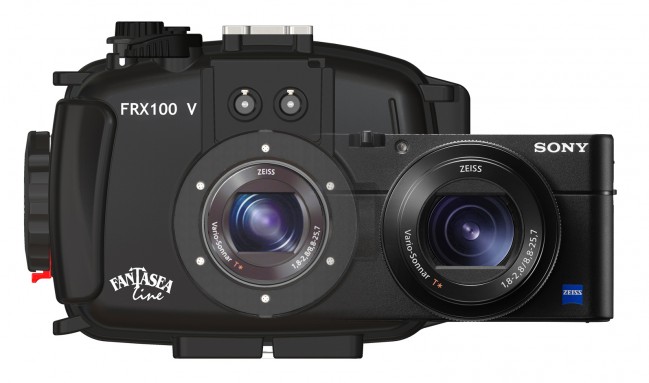
Read our review on the FRX100 V bundle
Canon G7X Mark III with Fantasea Housing | US$1099.95

Read our review on the FG7X II Bundle
Olympus Tough TG-6 Bundle | US$679

Nauticam LX100 Housing | US$1200

Check out this System Suggestion for the LX100
DSLR and Mirrorless Cameras
These are the heavy hitters. The serious tools for divers who want the highest possible image quality underwater.
DSLR and mirrorless cameras are interchangeable-lens systems with larger sensors, better dynamic range, superior autofocus, and full manual control. Modern mirrorless bodies have largely replaced traditional DSLRs in size and popularity, but both platforms are capable of producing industry-leading underwater images and professional-level video.
Large sensors and high-quality optics make a visible difference, especially in:
-
Low light performance
-
Dynamic range
-
Sharp macro detail
-
Color depth
-
Video quality
Above water they’re powerful. Underwater, they’re exceptional.
What Makes Them More Complex
With that performance comes complexity.
Because these cameras are larger, their underwater housings are:
-
Bulkier
-
More expensive
-
Heavier to travel with
You’ll also need to manage:
-
Interchangeable ports
-
Port extensions
-
Zoom and focus gears
-
O-rings and proper sealing
Each additional component increases setup time and introduces more room for user error if not assembled carefully.
These systems also provide full control over exposure, focus modes, custom settings, and video options. That flexibility is fantastic, but it requires strong buoyancy skills and comfort underwater. You must be able to operate the camera without compromising safety, awareness, or marine life.
Hopefully that didn’t scare you off.
Why People Choose DSLR or Mirrorless
The results speak for themselves.
With a properly configured system, you can produce:
-
Tack-sharp macro images
-
Vivid, wide angle reef scenes
-
Professional-quality video
-
Excellent performance in challenging conditions
For experienced divers and dedicated photographers, the creative control and image quality are unmatched.
Choosing a System
When investing in an interchangeable-lens underwater system, it’s often wise to choose the housing first. The housing is typically the larger financial investment, and it determines compatibility with ports, lenses, and accessories.
Mirrorless systems generally reduce overall size and cost compared to traditional DSLRs, since the housings are smaller and often slightly more affordable. Operationally, however, the experience is very similar.
If you already own a DSLR or mirrorless camera and want to take it underwater while staying mindful of budget, there are entry-level housing options available that allow you to build your system gradually.
Sony A6400 with Fantasea FA6400 Housing Bundle | US$1996

Read our review on the Sony A6500 Bundle
Nauticam D7500 Housing | US$3300
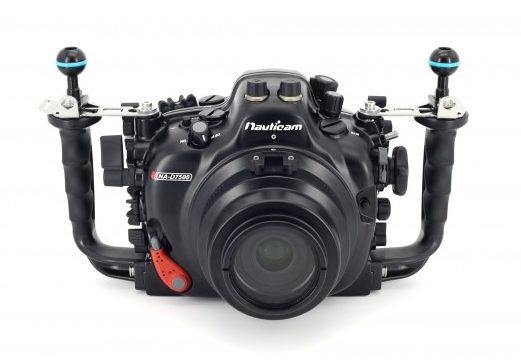
Ikelite Mini-DSLR Bundle – Canon SL3 / 250D | US$2045

Dedicated Video Cameras
If your main focus is underwater video and you’re not particularly interested in still photography, you might consider a dedicated camcorder paired with a video housing.
These housings are typically elongated to match the shape of traditional video cameras. They generally fall into two categories: mechanical and electronic.
Mechanical housings operate using levers and buttons that physically press the camera’s controls inside the housing. This is similar to how DSLR and mirrorless housings function.
Electronic housings, on the other hand, connect directly to the camera using internal wiring. Controls are transferred to an external control panel, often positioned ergonomically so that key functions are literally at your fingertips. This can make operating exposure, zoom, focus, and record functions more fluid during a dive.
Some video housings offer interchangeable ports, while others come with fixed ports depending on the design and intended use.
One of the well-known options in this niche is housing systems from Mangrove, which has long produced dedicated camcorder housings designed specifically for underwater video work.
A Reality Check
It’s important to note that this category is slowly fading.
Many manufacturers have discontinued their camcorder housings. At present, Mangrove remains one of the few brands still offering dedicated solutions in this space, and even that may not continue indefinitely.
Camcorders underwater are becoming increasingly rare. Most modern underwater videographers now use:
-
High-end compact cameras
-
Mirrorless systems
-
DSLRs
-
Dedicated cinema cameras
These platforms offer better sensor performance, interchangeable lenses, and stronger hybrid capabilities for both photo and video.
Unless you are specifically committed to a traditional camcorder workflow, most divers today will achieve better flexibility and long-term value from a compact or mirrorless system.
Mangrove MVHC-XL Underwater Video Housing | US$2288

For more options, read our ultimate guide for the Best Underwater Cameras in 2020.
If you’re still having a hard time choosing which camera to buy, consult with the rest of our Buying Guides, or simply contact our agents via the online chat and we will help you out!

Visit his personal portfolio at www.ranmorphoto.com.
