
 CAD
CAD
JUST GO WITH IT
If life underwater were predictable, diving wouldn’t be the popular sport it is today. As underwater photographers, we have to make pre-dive gearing decisions based on our best guess of what will end up the intended subject. If sharks or big animals are expected, we can affix a wide-angle lens and dual strobes. If the dive will be mostly cave diving, a focus light and auxiliary dive torches can be prepared depending on the intended shot.
Sometimes we get to a dive site having done our homework and conditions just aren’t as advertised. What then? This article seeks to inspire utilizing life’s little surprises to create unique, often once-in-a-lifetime shots. The ability to use what life deals is part of what defines each photographer’s style.
Diving Dictated by Lenses
There are as many styles of diving as there are sets of conditions. One of the major choices for the underwater photographer is that of the lens. When it comes to lenses, we are really only talk three choices: zoom, macro and wide-angle.

- Zoom lens photographers are ready to document just about anything. Zooms work best in situations where you have no idea what to expect. The resulting dives tend to be highly adaptable, switching readily from macro to pelagics as the situations arise.
- Macro photographers will be meticulous, leaving no stone unturned and no crevice unexplored. The most popular macro lenses are known as prime lenses. Prime glass simply has a fixed focal length, which sounds limiting at first, but allows for fast focusing and tack-sharp images. Therefore, a dedicated prime macro lens will produce higher quality images than a zoom, but limit a diver to shooting only the smallest organisms on the reef. If a dedicated macro photographer swims more than a few hundred yards over the course of the dive, there probably wasn’t much to shoot and the dive was probably a bust.
- Finally, wide-angle lenses are popular both for Close Focus Wide Angle and to shoot up-close portraits of large animals.
There are generally two strategies that accompany wide-angle lens photographers. Some photographers will enter the water and swim a huge distance hoping to cover as much ground as possible in the hope of finding a large animal. Others will tend to sit in one spot and hope the animals will come to them. Both strategies have their virtues and work some of the time.
When things go awry
A challenge arises when a wide-angle shooter finds a plethora of nudibranchs or the macro photographer has that once in a lifetime encounter with overly friendly macrofauna. Some recent encounters brought me to the realization that a little creative input can turn an adverse situation into a one-of-a-kind image.
The first such image I lost my cool and came away with a few pics to simply document the experience. I was lying perfectly with a portrait/macro lens still hoping to not disturb my intended subject, a Fisher’s angel fish (Centropyge fischeri). The fish spooked, but not from anything I had done. When I looked up from the viewfinder, a large tiger shark was circling me close enough to scare the subject! Having never encountered a tiger before, I shot off a couple of panicky pics just as proof thinking I wasn’t set up to deal with a close-range shark appropriately.
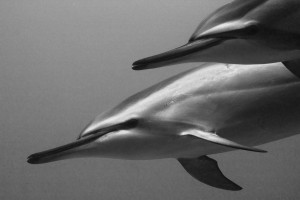
It wasn’t until years later that I figured it out. Having made more than ten recent dives with a wide-angle fisheye and nothing significant to show for it, I switched to a macro. We had barely got to depth when a playful pod of dolphins showed up and swam with us for a good 10 minutes. They shadowed me

especially, swimming in an arc over me and through the perfect sunburst for an incredible fisheye shot. Unfortunately, the wide-angle lens was safely in its Pelican case at home. Making the most of the situation, I turned to shooting dolphin portraits and came away with some unique angles on dolphins. The very next dive I had a similar experience with an affable manta ray.
It seems if you really want to see big wildlife, affix a macro lens.
Other situations to just go with it
The underwater environment is not climate controlled. Time and again, we plan days off at the ocean based on the best available data only to have conditions think otherwise. Wind chop, water murk, and backscattering plankton blooms can all ruin an otherwise perfect day of shooting.
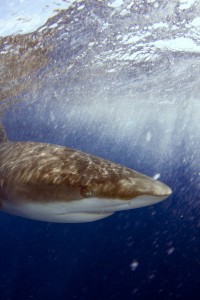
The concept of optimism in spite of adversity is exemplified by my only encounter with blue sharks off Rhode Island. Ample bait meant the sharks were raucous and quite workable. My recollection of the conditions was one of green water and rough seas. Combining basic guidelines such as shooting up with creative strobe and camera angling led to the creation of some epic shots of blue sharks made more exciting by the inclusion of particulates. The application of a bit of optimism turned a rough day into a win.
Bubbles can also cure a boring blue background. In the case below, a pole camera was placed in the water next to the boat while the operator chummed up a bunch of Galapagos sharks. This portrait could have had an unremarkable blue background, but the bubbles added a touch of excitement while breaking the azure monotony.
Some backscatter can be used for other effects as well. Blackwater diving puts divers in the water miles offshore from continental shelves at night to witness the vertical migration of mesopelagic plankton. The precedents in place call for a clean black background that can only be achieved through heavy cleaning in Photoshop. The inclusion of some plankton is a break from the norm that can simultaneously create a spacey feel to the photo and save time sitting at a computer.
We cannot always know what will be swimming just beneath the waves for the same reason that weathermen aren’t to be trusted: nature has a mind of its own. Rolling with the punches to shoot through adversity is what makes for truly unique shots. Better yet, look for the challenging conditions to find the special circumstances for your next winner.

- The Case for Shark Feeding – March 27, 2014
- Create Your Own Luck – January 26, 2014
- Starting out in Underwater Photography – December 25, 2013
