
 CAD
CAD
Thailand, a New Black Water Diving Destination
Thailand has always been known for its colorful reefs, but have you heard of blackwater diving in Thailand?
Every night, attracted by the moonlight, marine life leaves the deepest ocean depths in order to satiate its curiosity and hunger in shallower waters. To mimic the natural moonlight and to attract this larval and pelagic life to the surface, a downline is dropped over very deep waters, with powerful lights placed along its length. 
Using their own torches and minimal movement, divers search for a hint of color or reflection, then get closer to identify their subject or, better yet, photograph them.
Blackwater diving began with a handful of experienced dive photographers curious enough to try diving at night in the open sea where the bottom drops to several hundreds meters.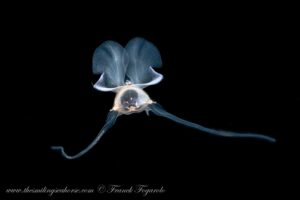
After years of growing popularity in Hawaii, the Philippines and Indonesia, incredible blackwater diving areas are now being found throughout the pristine waters of Thailand.
History
Thailand’s blackwater diving story began a few years ago in Koh Tao, led by photographer (and Mozaik contributor) Alex Tyrrell, who returned with years of experience blackwater diving in the Philippines.
A second blackwater diving line has since been launched near Pattaya, in the Gulf of Thailand, by divers from Bangkok willing to discover this new way of night diving and more recently The Smiling Seahorse became the first liveaboard on the Andaman Sea offering Blackwater diving as an option of its every cruise on the Andaman Sea.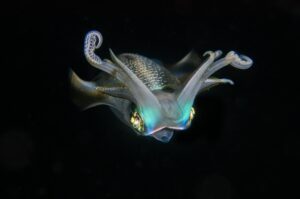
Divers and underwater photographers have become hooked on the rare and incredible finds on these new dives, particularly those recently discovered in the Andaman Sea.
With its unique combination of tropical water, deep sea floors, and mild currents, western Thailand blackwater sites have revealed a rich pelagic life that cannot normally be seen near the reefs
Species to see
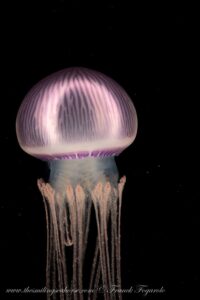
Jellyfish and juvenile sea species are the most common during these special dives and will often be in your sphere of light before you notice their presence – think myriads of squid, tiny octopus, wiggly worms, and iridescent salps.
Larger subjects such as pelagic sea snakes or snake eels can be seen, but most invertebrates, plankton, and fish seen on blackwater dives are much smaller.
Still in their immature stage, the best subjects showcase large eyes, unique appendages, and iridescent hues mimicking dangerous jellyfish to survive the largest animal migration on the planet.
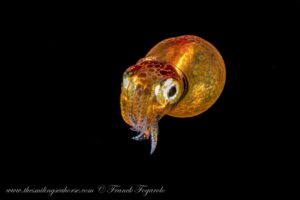 From the Depths
Some blackwater dives have even presented deep-sea marine life that is normally only seen by high-tech submarine footage. But the natural structure of the Andaman Sea shows that just beyond the shallow reefs along the coastal regions of Thailand, there are quickly seen depths of 180-300 meters, before dropping to as deep as 3,000 meters, with canyons recorded at over 4,000 meters deep.
While life at 4,000 meters will likely not be seen near the surface in mature life stages, they are most certainly among the larval creatures found drifting in the shallow currents on a blackwater dive.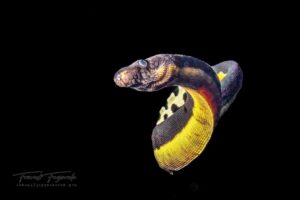
This is particularly exciting for underwater photographers!
While first-time blackwater divers may initially have difficulty identifying species, underwater photographers have the added benefit of being able to review photographs after the dive, making comparisons between what has been captured on film versus established developmental and growth patterns of local species.
Similan Islands is a diving destination renowned for macro and pelagic life, and by including it on each of this season’s dive tours, we’ve confirmed that it’s also excellent for blackwater diving and photography.
All the photos from this article were taken in Thailand by Franck Fogarolo, the cruise director onboard The Smiling Seahorse, a liveaboard particularly geared towards underwater photographers.
On our first blackwater dives, we encountered a juvenile tripod fish, a deep-sea species we had not seen in the last 10 years of diving local reefs, as well as a juvenile sailfish – two rare finds in blackwater diving around the globe.
This season alone, we spotted dozens of Paper Nautilus, both males and females, who made a show for our camera – they are one of the most sought after subjects of blackwater photographers.
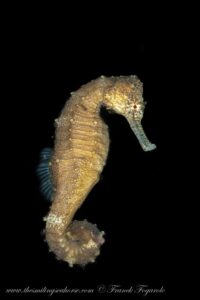
We have also seen juvenile stages of more common Andaman Sea fishes including gastropods (snails and slugs), cephalopods (loads of squid and octopuses), salp and jellies, seahorses and pipefish, triggerfish and flying fish, sailfish, and crustaceans (shrimps, crabs, and mantis) – some smaller than your fingernail, and all showcasing ornamental detail.
It was particularly interesting to see a juvenile flounder, whose eyes had not yet migrated to one side of its body, as it had not yet grown or adapted enough to settle into the sandy bottom closer to reefs.
Blackwater diving photography also delivers exciting opportunities for practicing macro night diving techniques – you’ll be tracking and shooting pea-sized reflective and transparent life in the dark!
Blackwater image capture tips
The variety of size, transparency, movement and character in the subjects of blackwater diving are best captured through a 60mm macro lens, with close focusing distance for the smallest critters, and quick auto-focus to capture them before they float away.
We recommend reviewing images at the time of shooting to ensure focus is sharp. To avoid overexposing reflective subjects, set up highlights warning so that adjustments can be made quickly. 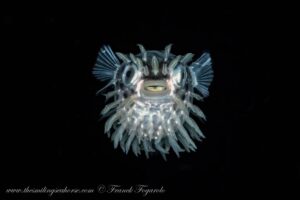
These tiny juveniles are tough to frame, so you don’t want to do too many adjustments between shots. The good presets are fast shutter speed, closed aperture and high ISO allowing low strobe power for fast recycling time.
Accept some backscatter and cropping as part of the postprocessing where you can decide which feature stands out to you, and which to highlight. After spotting subjects with your primary torch, use a focus light for shooting.
If you’re lucky and get the right conditions, surface ripples and reflections can also add drama to your images.
If you are not a photographer, there is still so much to see and experience. Divers who enjoy macro or muck diving, with practiced buoyancy and breathing skills, will also find this search for these elusive “baby sea monsters” undeniably alluring.
To explore the larval and juvenile “little monsters” of the Andaman, a Liveaboard is the way to go. Contact us for more details.

- Thailand, a New Black Water Diving Destination – May 24, 2022
- The Best Techniques to Shoot Fast-Moving Subjects Underwater – November 15, 2021
